
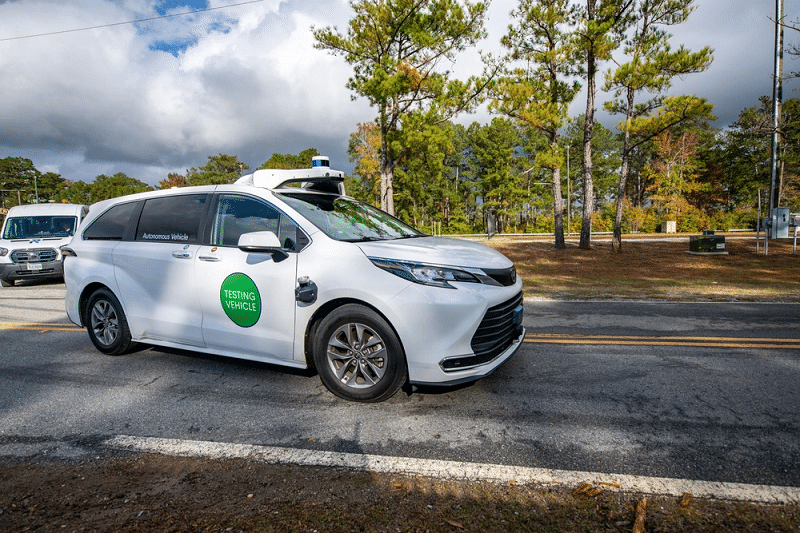
NOVEMBER 9, 2026 – Five autonomous vehicles arrived at Fort Benning Nov. 4 as part of the Robotic Operations for Autonomous Delivery and Sustainment (ROADS) prize challenge, a pilot initiative executed in partnership with the Defense Innovation Unit (DIU) to evaluate commercial self-driving technology on military installations.
As one of two host installations selected for the ROADS challenge, Fort Benning will integrate a mixed fleet of six total vehicles – four electric and two hybrid – from three commercial vendors: Applied Intuition, Forterra/May Mobility, and Perrone Robotics.
“Every day, thousands of initial-entry trainees, permanent-party cadre, and tenant unit Soldiers move across Fort Benning’s expansive ranges, cantonment areas, and support facilities,” said Charles Auer, Chief of Future Operations at Fort Benning’s Directorate of Plans, Training, Mobilization and Security (DPTMS) and installation lead for the pilot. “Sustaining that constant personnel movement requires continuous vehicle dispatching and dedicated drivers: administrative and logistical requirements that draw our Soldiers away from primary tactical and training duties.”
While the broader ROADS challenge explores both logistics and personnel transit, Fort Benning’s pilot program focuses specifically on passenger shuttle applications. By integrating commercial autonomous shuttles into everyday administrative routes, the command aims to reduce Soldier driver duty requirements and return instructional hours back to cadre across the installation.
During the initial mapping phase, which is expected to take two to three weeks, the vehicles will be operated manually by human drivers as teams collect Light Detection and Ranging (LiDAR), video, and GPS data to build the system architecture. The vehicles will remain within pre-approved on-post routes, operating only on hard paved roads.
Vehicle routes explicitly exclude sensitive installation facilities, including Lawson Army Airfield, Ammunition Supply Points, and tactical compounds.
Following the completion of the mapping phase, vendors will start phased demonstrations and test runs through the end of 2026. This planned progression will allow Fort Benning and DIU to use early feedback to improve operational practices. They will then evaluate whether vehicles can safely and effectively operate on military installations before transitioning to fully autonomous operations.
“Safety remains the overriding priority throughout this pilot,” said Auer. “Before we transition to completely driverless operations, each vehicle will undergo rigorous testing with a safety driver on board, allowing us to move rapidly toward autonomous capabilities while ensuring a safe, phased deployment on our installation.”
Story by Maddy Gonzalez
Fort Benning Public Affairs Office